
Last updated September 21, 2026
Full 25-point door and opener safety check with every visit - springs, cables, rollers, tracks, and your LiftMaster or Chamberlain opener included
You get a price before we start. It does not change when the truck arrives.
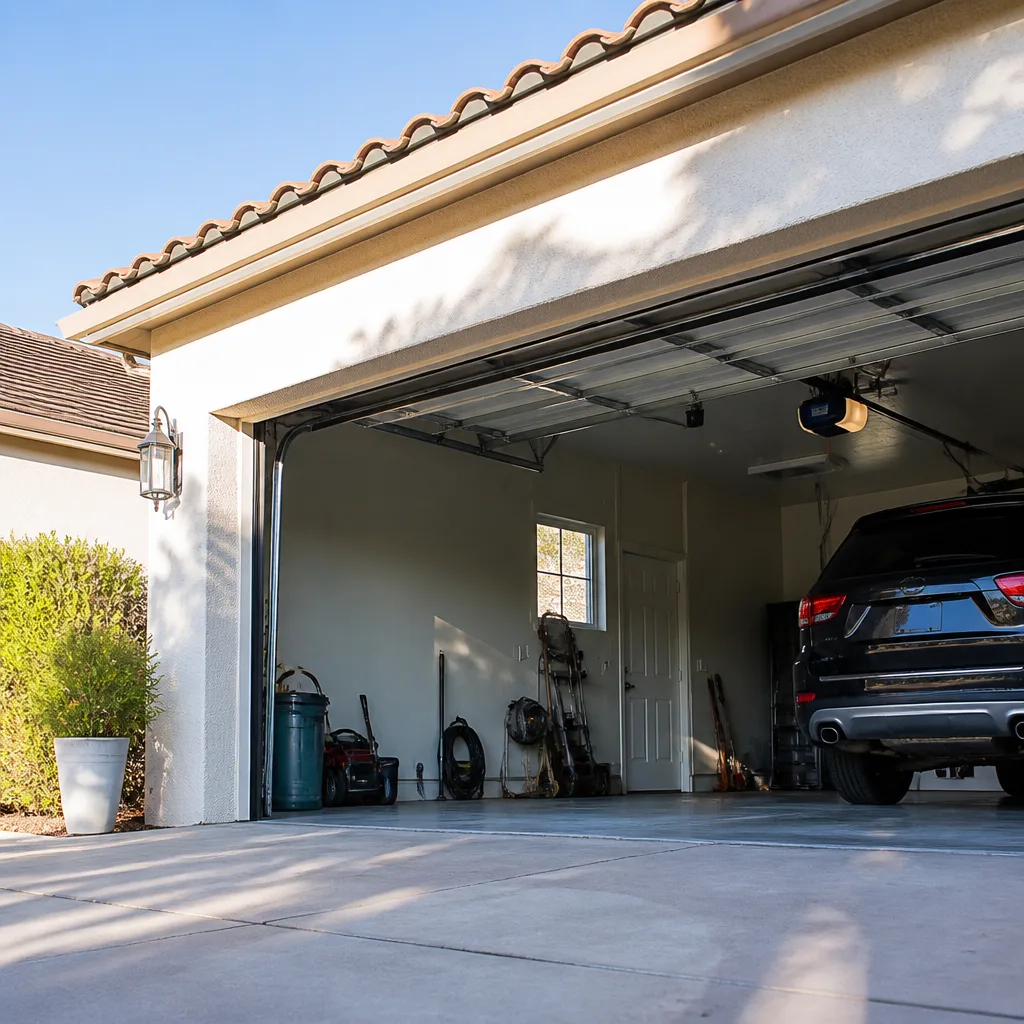
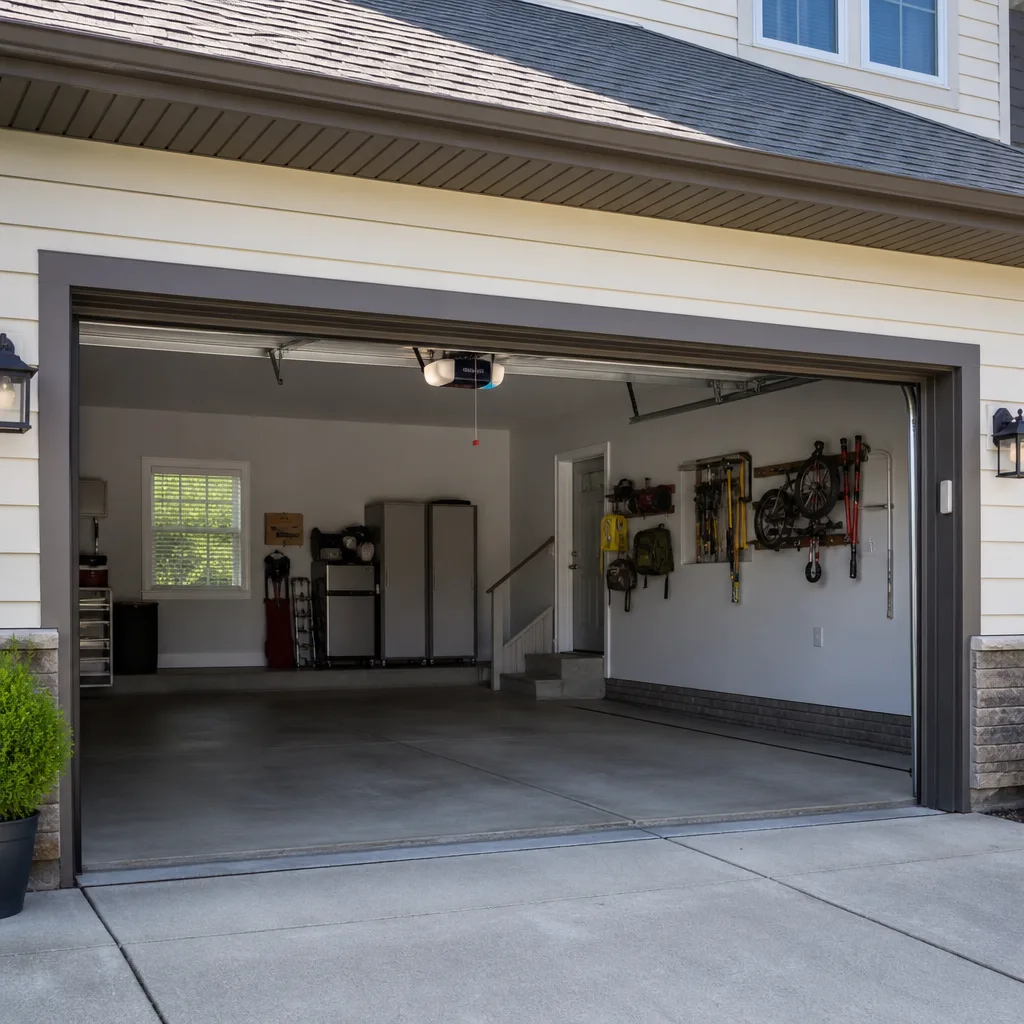
 Before
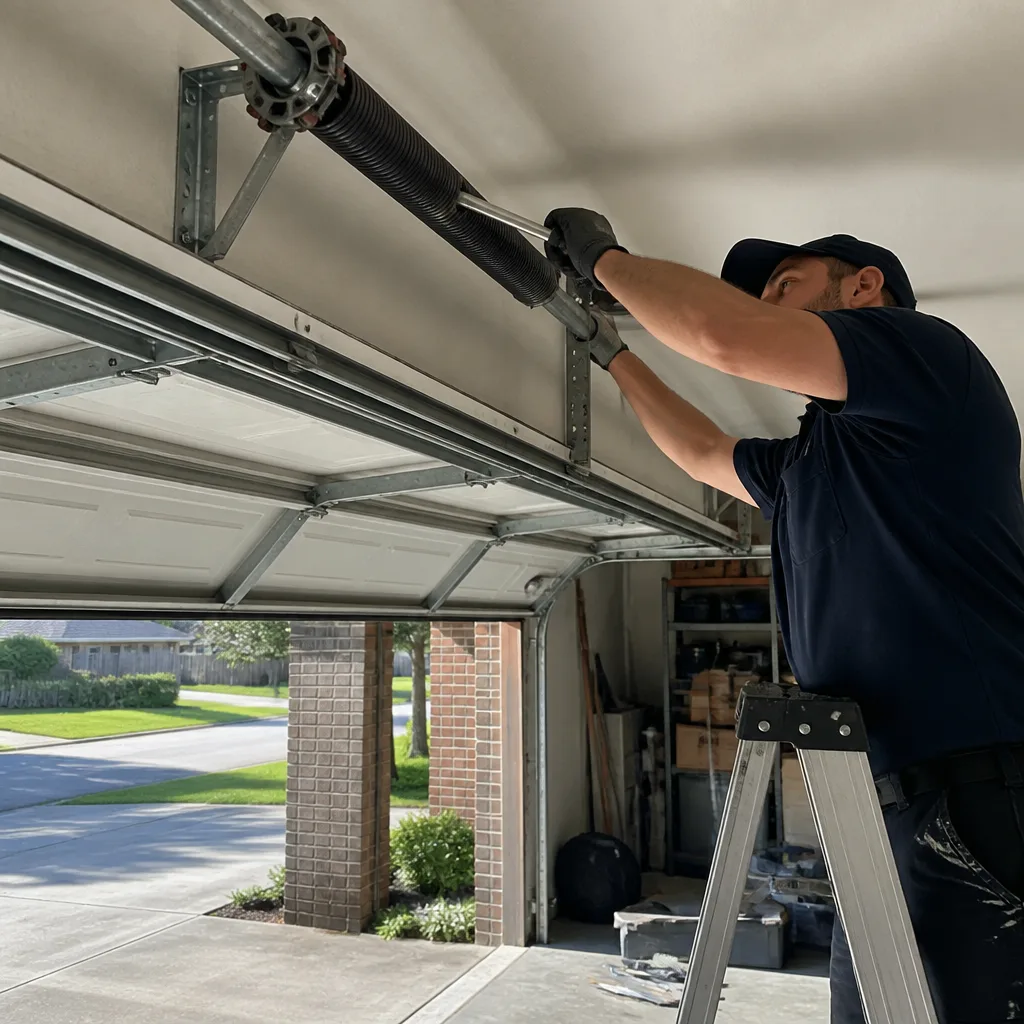 After
After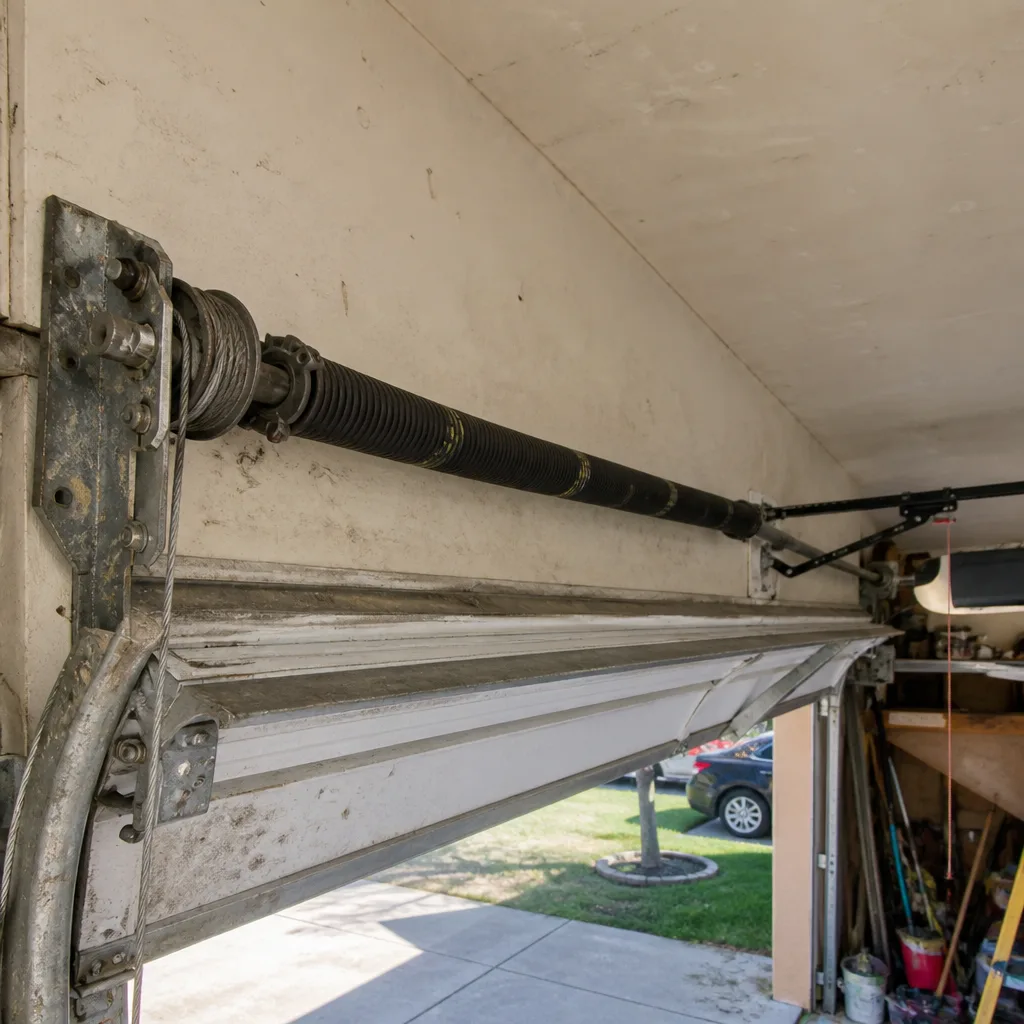 Before
 After
After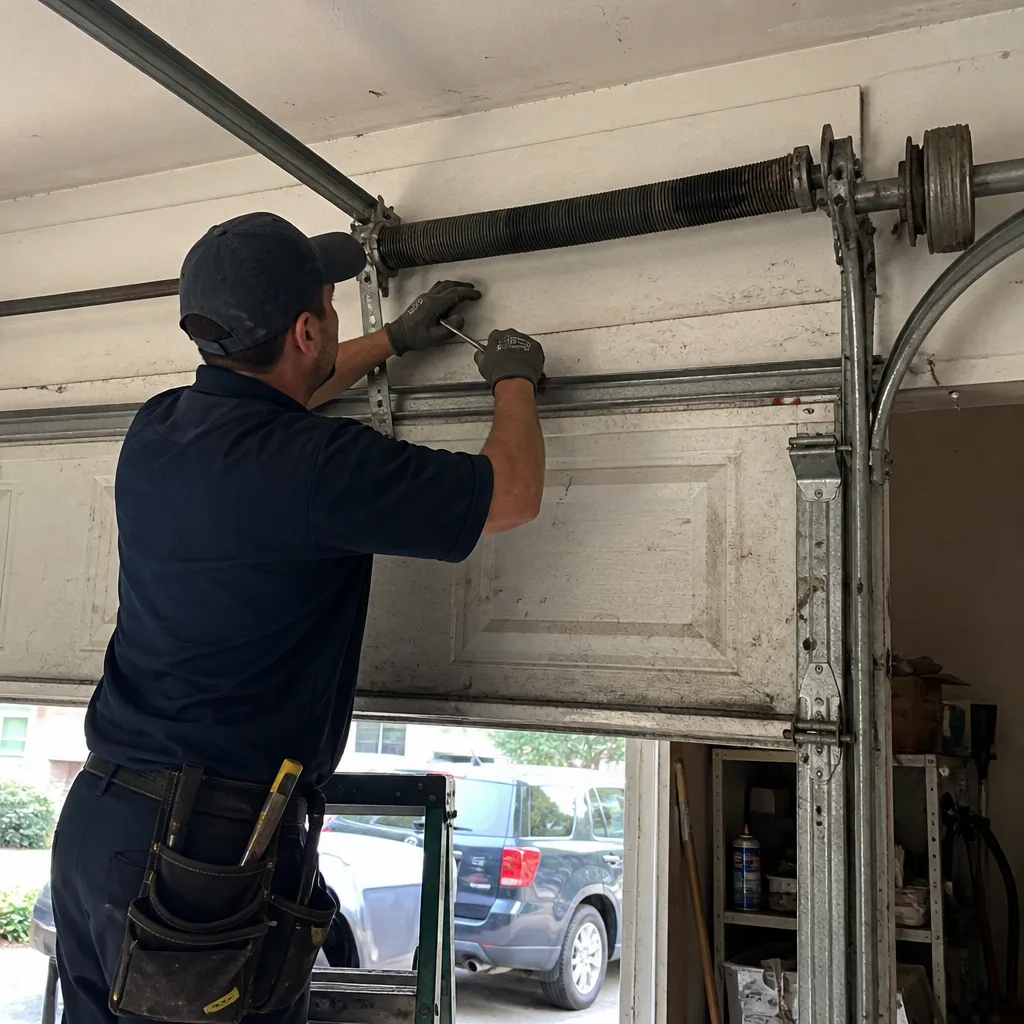 Before
 After
AfterSeasonal Garage Door Care for Atascocita: Year-Round Homeowner’s Guide
The conventional spring-and-fall maintenance schedule assumes a temperate climate. In Atascocita, a garage door endures more thermal cycling in August alone than a Denver door experiences across three months. That means the optimal lubrication and spring-tension check schedule here runs on a different calendar entirely. This guide is built around Atascocita’s actual weather calendar: a corrosive summer that lasts five months, a compressed cold window of six to eight weeks, and two brief shoulder periods where the real maintenance work should happen. We’ll show you what to check, when to check it, and which tasks are safe to handle yourself versus when a trained technician should take over, with guidance from our DIY vs Professional Garage Door: The Atascocita Homeowner’s Decision Guide.
Quick Answer
Garage door maintenance in Atascocita should follow a heat-driven schedule: pre-hurricane checks in March-April, summer lubrication with high-temperature grease in May, a post-summer cable and spring audit in October, and spring-tension adjustments during the December-January cold window when metal dimensions are stable. Skip the generic four-season approach; the Gulf Coast climate demands targeted timing.
Table of Contents
- Pre-Hurricane Season Checklist: March-April
- Summer Heat Protocols: May Through September
- Post-Summer Audit: October
- The Cold Window: December-January
- Humidity Corrosion Schedule
- Lubrication Guide: What, Where, and When
- DIY Maintenance vs. Professional Service
- Common Mistakes to Avoid
- When to Call a Professional
- Frequently Asked Questions
 Before
 After
AfterPre-Hurricane Season Checklist: March-April
Hurricane season officially opens June 1, but the preparation window in Atascocita closes earlier than most homeowners realize. By late April, supply chains strain and contractor calendars fill. The garage door is the largest moving wall in your house and the most common failure point during a storm. A compromised door can pressurize your garage, damage your roof from the inside out, and void your homeowners insurance if pre-existing wear is documented after a claim.
We recommend a three-point inspection every March, with documentation. Here’s what to check:
- Bottom seal integrity. The rubber or vinyl seal along the door’s bottom edge hardens in Atascocita’s summer heat, then cracks when winter cold arrives. In March, run your hand along the seal feeling for brittleness, gaps, or sections that no longer rebound when compressed. A failed seal admits wind-driven rain and creates the pressure differential that tears a door from its tracks during a storm. Replacement cost in the Atascocita market runs $45-$85 for standard seals, $120-$180 for heavy-duty bulb-style seals with integrated wind load ratings. We stock both at Servo Garage Doors Atascocita.
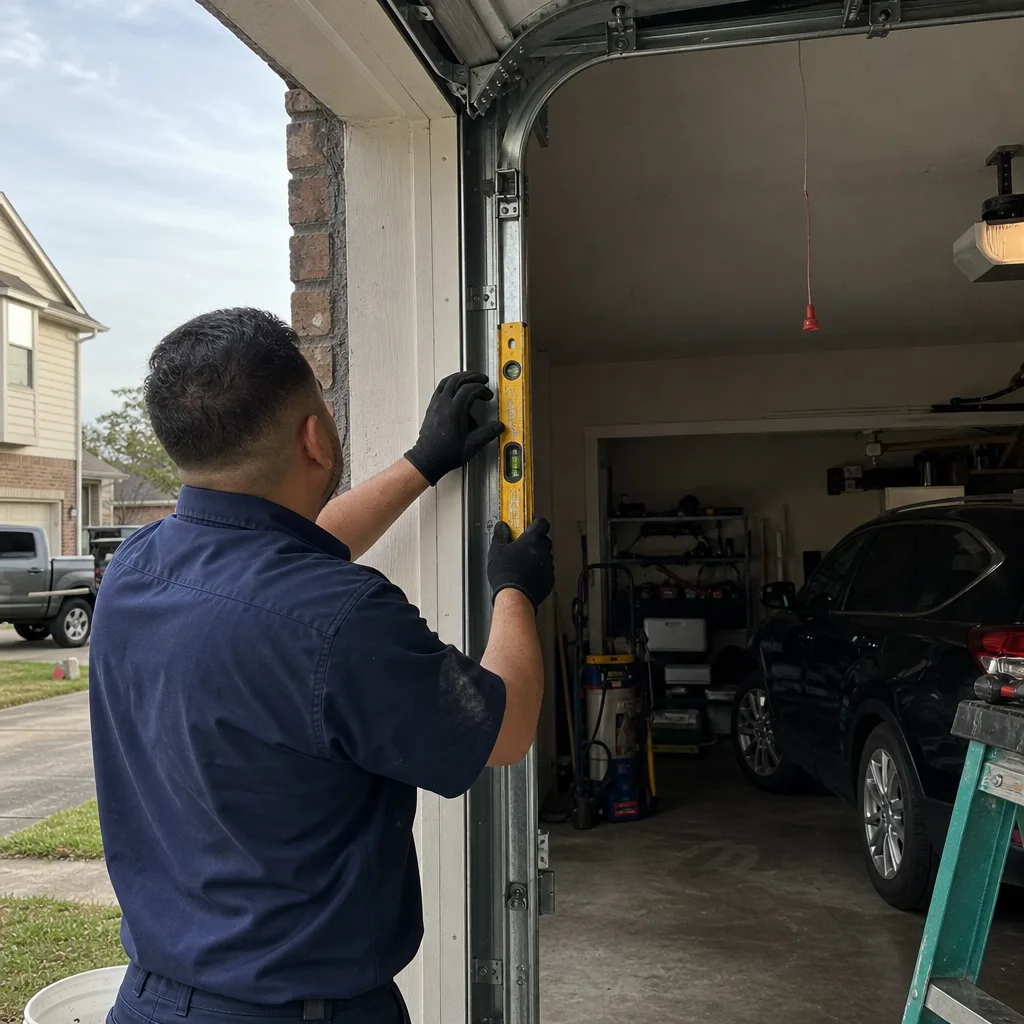
- Track anchor bolt torque. The vertical tracks are held to the door jamb by lag bolts or concrete anchors. Thermal expansion from five months of 95°F+ heat cycles loosens these faster than in cooler climates. Check for rust streaks below bolt heads, which indicate water intrusion and loosening. Do not over-tighten; finger-tight plus a quarter turn with a socket wrench is sufficient. Stripped anchors require professional re-drilling and epoxy-set replacement bolts.
- Emergency disconnect rope condition. The red-handled rope that releases the trolley from the opener carriage must move freely and show no fraying. After Hurricane Harvey, we found dozens of Atascocita doors where homeowners had cut the rope short for aesthetics, then couldn’t disengage the opener when power failed. The rope should hang 6 feet from the floor, per manufacturer specification, with a handle that grips when wet.
In the Pinehurst and Walden subdivisions, where garage doors face west and catch full afternoon sun, we see bottom seal degradation 40% faster than east-facing installations. If your door faces west, move this inspection to February.
Document your findings with dated photos. If you call us for Garage Door Repair in Atascocita, we’ll add them to your file and reference them against our own inspection.
Summer Heat Protocols: May Through September
Atascocita’s summer is not merely hot; it’s thermally violent. Daily highs above 95°F followed by overnight lows in the mid-70s create a 20-degree swing every 24 hours. Steel tracks, springs, and hardware expand and contract through this cycle. The wrong lubricant turns to liquid and drips onto your car. The right lubricant maintains its film strength.
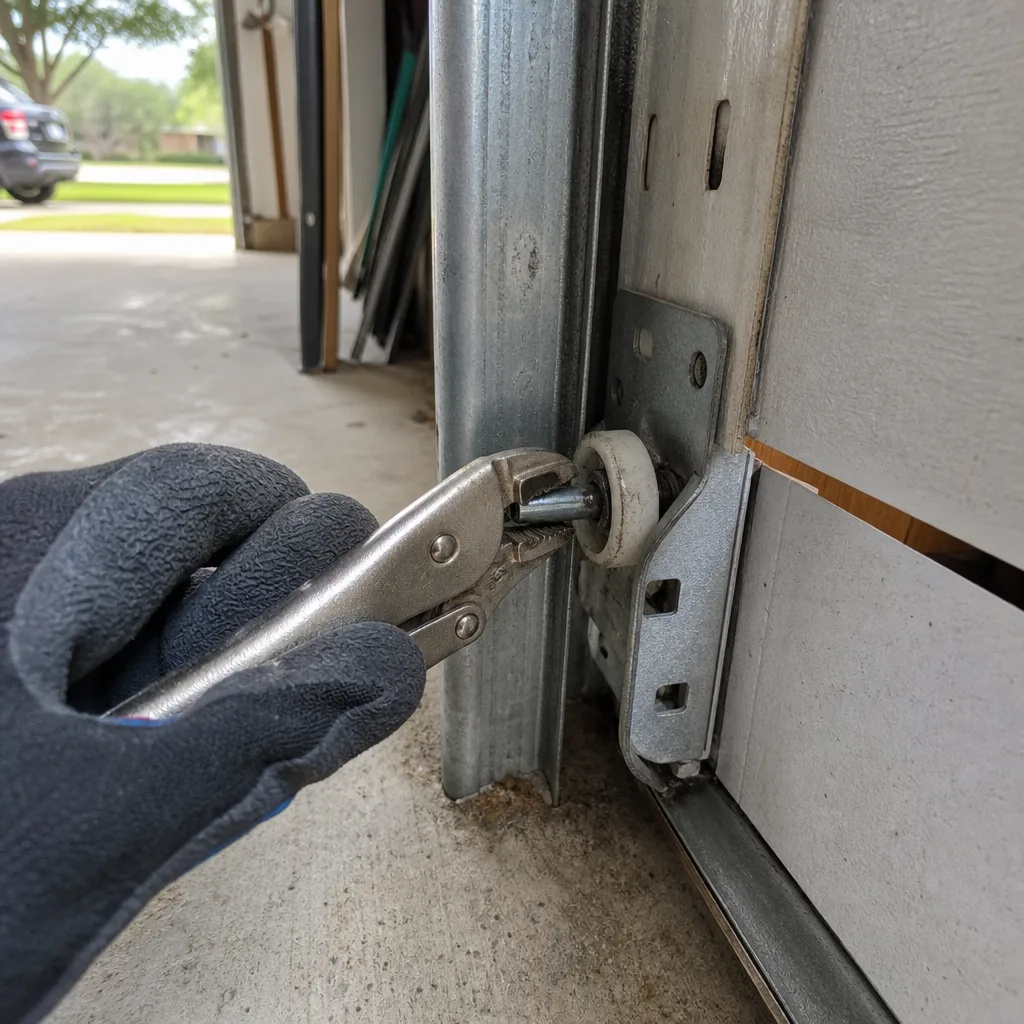
Lubricant viscosity for Gulf heat. Standard white lithium grease, adequate for climates with narrower temperature ranges, thins excessively above 90°F. In Atascocita, we specify a high-temperature synthetic grease with NLGI Grade 2 consistency and a drop point above 450°F. This stays where it’s placed on hinge pins and roller stems through August afternoons. Apply sparingly: a pea-sized amount per hinge, worked in with a rag to coat the pin without attracting dust. Excess grease collects grit and becomes abrasive paste.
Roller wear acceleration. Nylon rollers, common on Clopay and Amarr doors installed after 2015, soften in sustained heat. The wheel deforms slightly under load, then cools in a non-round shape. After three Atascocita summers, we measure ovality exceeding 1/16 inch on rollers that showed no wear at installation. Steel rollers with sealed bearings tolerate heat better but require the same high-temperature grease. If your door rattles more in September than it did in May, rollers are the likely cause.
Opener thermal protection. Garage temperatures in Atascocita routinely reach 110°F in unventilated spaces. Chamberlain and LiftMaster openers manufactured after 2018 include thermal cutoff switches that halt operation above 120°F internal temperature. This is not a failure; it’s protection. If your opener stops mid-cycle on August afternoons, improve ventilation before calling for service. A solar-powered attic vent or louvered garage vent reduces peak temperatures 15-20 degrees and extends opener logic board life.
Monthly quick check (five minutes, first Saturday):
- Listen for new scraping or grinding sounds during opening
- Watch for jerky motion or hesitation at the same point in the cycle
- Check that the safety reversal beam (the two sensors near the floor) still align; heat expansion shifts brackets
- Verify the wall button LED is steady, not flashing
Any change from baseline warrants documentation. Small sounds become expensive repairs when ignored through five months of heat.
Post-Summer Audit: October
October is the most important maintenance month in Atascocita. Five months of thermal expansion have altered every metal component in your garage door system. Now, as temperatures moderate, those components settle into new positions. What was a barely perceptible change in May is now measurable wear.
Cable tension measurement. The lift cables that wind around the drums at each end of the torsion tube lose tension as springs weaken. With the door closed, the cables should show no slack and no fraying above the bottom fixture. We measure cable deflection at mid-span: more than 1/2 inch of sag with the door closed indicates spring fatigue or cable stretch. In Atascocita’s climate, we see this condition on 30% of doors over eight years old during October audits.
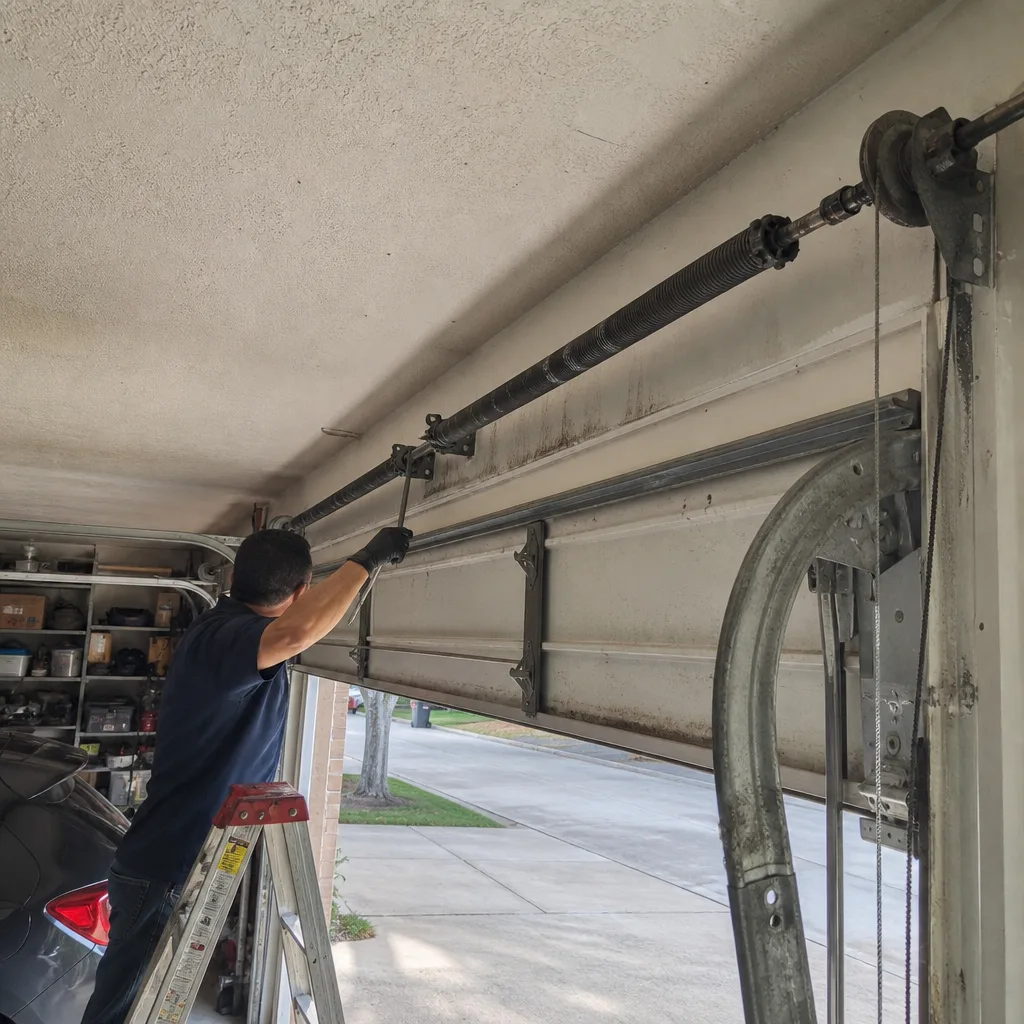
Spring set evaluation. Torsion springs are calibrated to a specific number of cycles (typically 10,000 for standard springs, 25,000-30,000 for high-cycle upgrades). Heat accelerates metal fatigue through a mechanism called creep: sustained stress below the yield point still causes gradual deformation. A spring that measured 0.250-inch wire diameter when installed may measure 0.245 inch after five Atascocita summers. That 2% reduction increases stress per coil and reduces cycle life disproportionately.
We check spring tension with the door in the closed position using a winding bar and calibrated gauge. The gap between coils, called the coil bind dimension, should be consistent. A collapsed section, where coils touch under load, indicates the spring has taken a set and lost torque. Replacement is the only safe option. Spring replacement in Atascocita ranges $280-$450 for a standard 10,000-cycle pair, $420-$650 for high-cycle springs with extended warranties; see our Garage Door Cost Breakdown: The Atascocita Homeowner’s Reference for 2026 for full pricing context.
Track alignment verification. Thermal expansion shifts vertical track mounting brackets, particularly on doors with aluminum tracks (common on Wayne Dalton and some Craftsman models). The door should rise without contacting either track. A rubbing mark on the track interior, visible as polished metal or paint wear, indicates misalignment. Left uncorrected, this creates a binding point that overloads the opener and distorts door sections.
October is also when we schedule Garage Door Installation in Atascocita for homeowners who’ve determined their door has reached end of life. Lead times shorten after the summer rush, and installation crews work in comfortable temperatures that allow proper adhesive curing for window inserts and sealants.
The Cold Window: December-January
Atascocita’s cold window is brief but precise: typically mid-December through late January, with overnight lows in the 30s and occasional hard freezes. This narrow period is the only safe time for certain adjustments, because cold-stabilized steel gives accurate measurements.
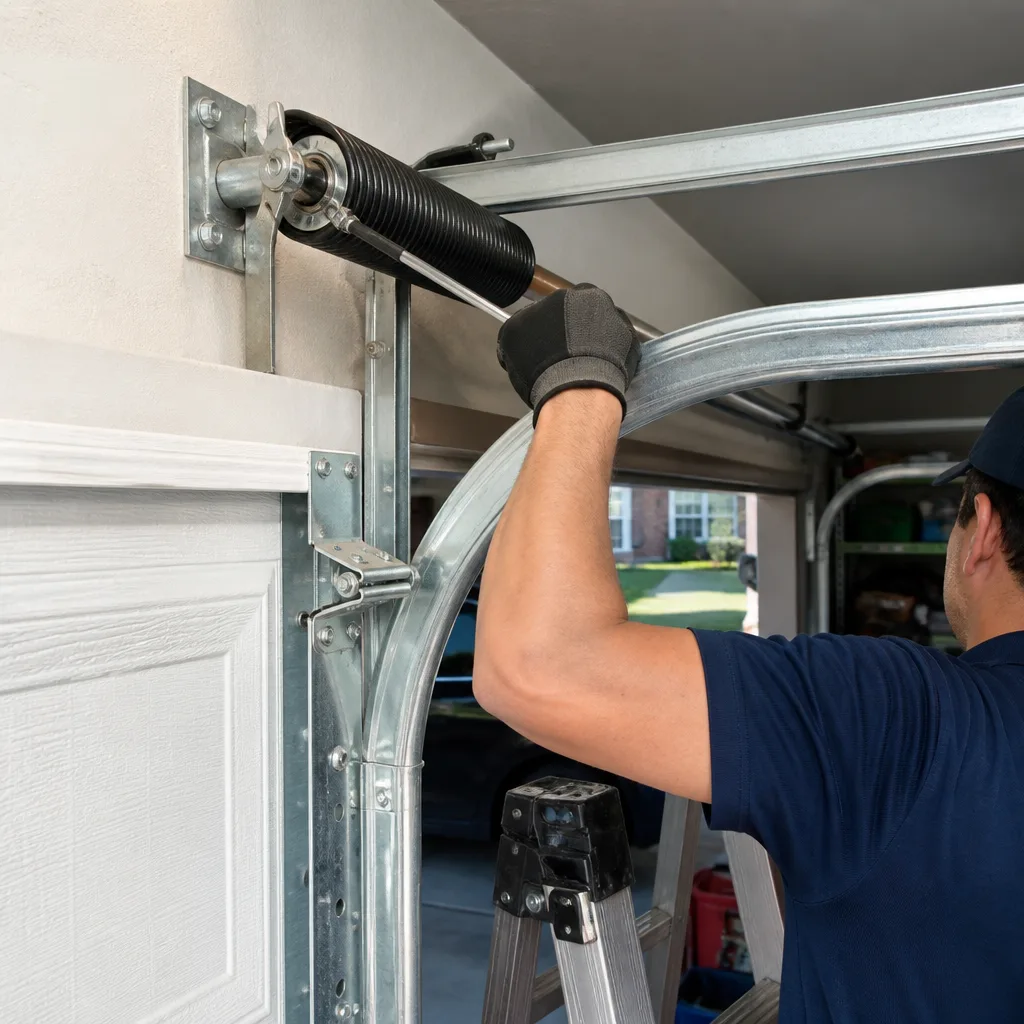
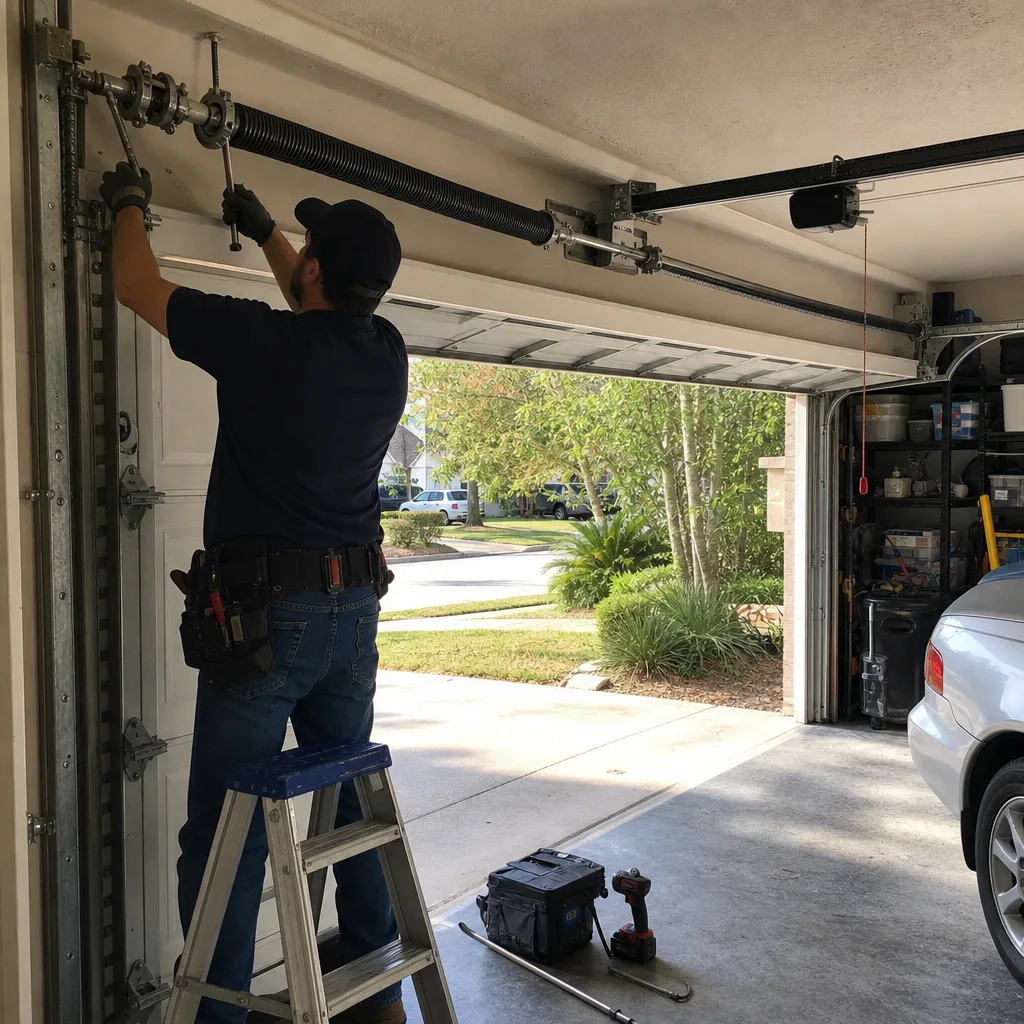
Spring tension adjustments. Torsion springs are torque-rated at 70°F. At 40°F, the same spring delivers approximately 8% less torque due to reduced metal elasticity. Attempting to adjust spring tension in summer heat, when the metal is expanded and more brittle, risks over-winding and sudden failure. In December and January, the spring’s dimensions are stable, and the adjustment reflects actual operating conditions.
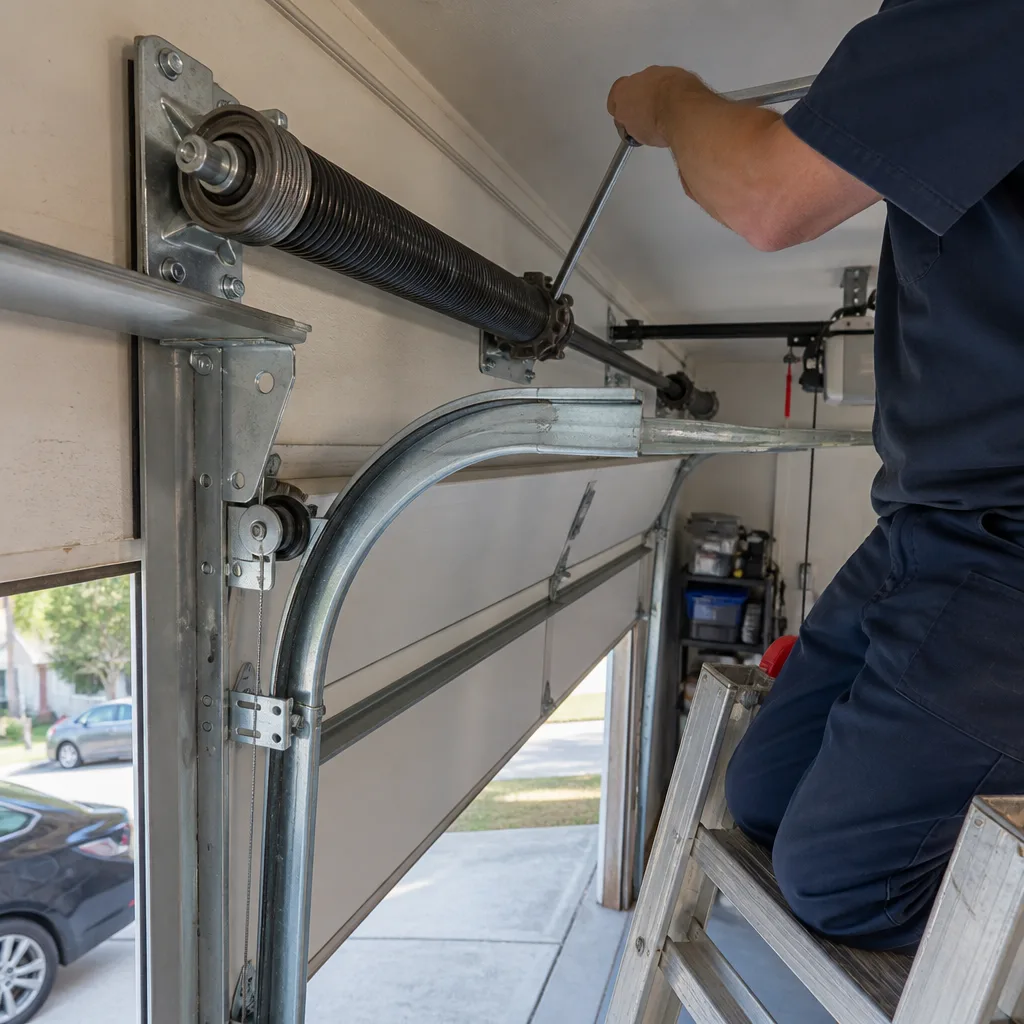
This is not a DIY procedure. The torsion spring stores enough energy to cause serious injury or death if the winding bar slips. Our technicians perform these adjustments with calibrated tools and two winding bars engaged at all times, per industry safety protocol. The cost for tension adjustment in Atascocita runs $120-$180, including rebalancing and safety reversal testing.
Limit switch calibration. The opener’s limit switches, which tell the motor when to stop at fully open and fully closed positions, drift as door weight changes with temperature. A door that closes fully in August may stop 2 inches high in January. Cold-window calibration ensures the door seals properly against the threshold, keeping heated garage air inside and preventing rodent entry.
Weatherstripping replacement. PVC and vinyl seals reach maximum brittleness at their coldest. Installing new seals in January means they’ll flex through the full annual temperature range without cracking. We keep heavy-duty EPDM rubber seals in stock, rated from -40°F to 250°F, which outlast standard PVC by 3-4 years in Atascocita conditions.
The cold window also reveals problems masked by summer heat. A door that operated smoothly at 90°F may bind at 40°F if rollers are worn or tracks are misaligned. Note any change and schedule service before the February warming trend, when expanding metal can convert a binding point into a jam.
Humidity Corrosion Schedule
Atascocita’s average relative humidity hovers near 75% year-round, with summer peaks above 85%. This is not coastal humidity, but it’s enough to initiate corrosion on unprotected steel within a single season. Understanding which components fail first lets you prioritize protection spending.
Single-season corrosion initiators:
- Bottom fixtures and cable drums: These sit lowest in the door system, where garage floor moisture accumulates. Galvanized steel fixtures show white rust (zinc oxide) within one humid season if the galvanizing is thin. We replace with hot-dipped galvanized or stainless steel hardware on doors in lake-adjacent Atascocita neighborhoods like The Groves, where humidity runs 5-10 points higher.
- Torsion spring mounting brackets: The bracket that anchors the spring tube to the header collects condensation from temperature differential between attic air and garage air. Surface rust here is cosmetic until it pits; pitting reduces cross-section and load capacity. Annual inspection with a wire brush and cold-galvanizing spray extends bracket life from 5 years to 12+ years.
Three-season corrosion timeline:
- Track interior: The zinc coating on rolled steel tracks wears from roller contact, exposing bare steel. Humidity initiates uniform rust that roughens the surface and accelerates roller wear. We see this on 15-year-old tracks in Atascocita; replacement tracks run $180-$320 per side installed.
- Chain or screw drive opener mechanisms: Chamberlain chain drives and Genie screw drives without periodic lubrication develop surface rust that increases friction and motor load. The opener works harder, draws more current, and fails prematurely. Annual lubrication with manufacturer-specified grease prevents this entirely.
Surface treatment that extends the window: For hardware in high-humidity garages, we apply a zinc-rich primer followed by enamel topcoat, or specify powder-coated replacement components. The powder coating process fuses the protective layer to the metal at 400°F, creating a barrier that outlasts paint by a factor of four. On a recent Garage Door Opener Repair & Installation in Atascocita in the Eagle Springs area, we replaced all hardware with powder-coated equivalents; the customer reported zero surface rust after three years.
Lubrication Guide: What, Where, and When
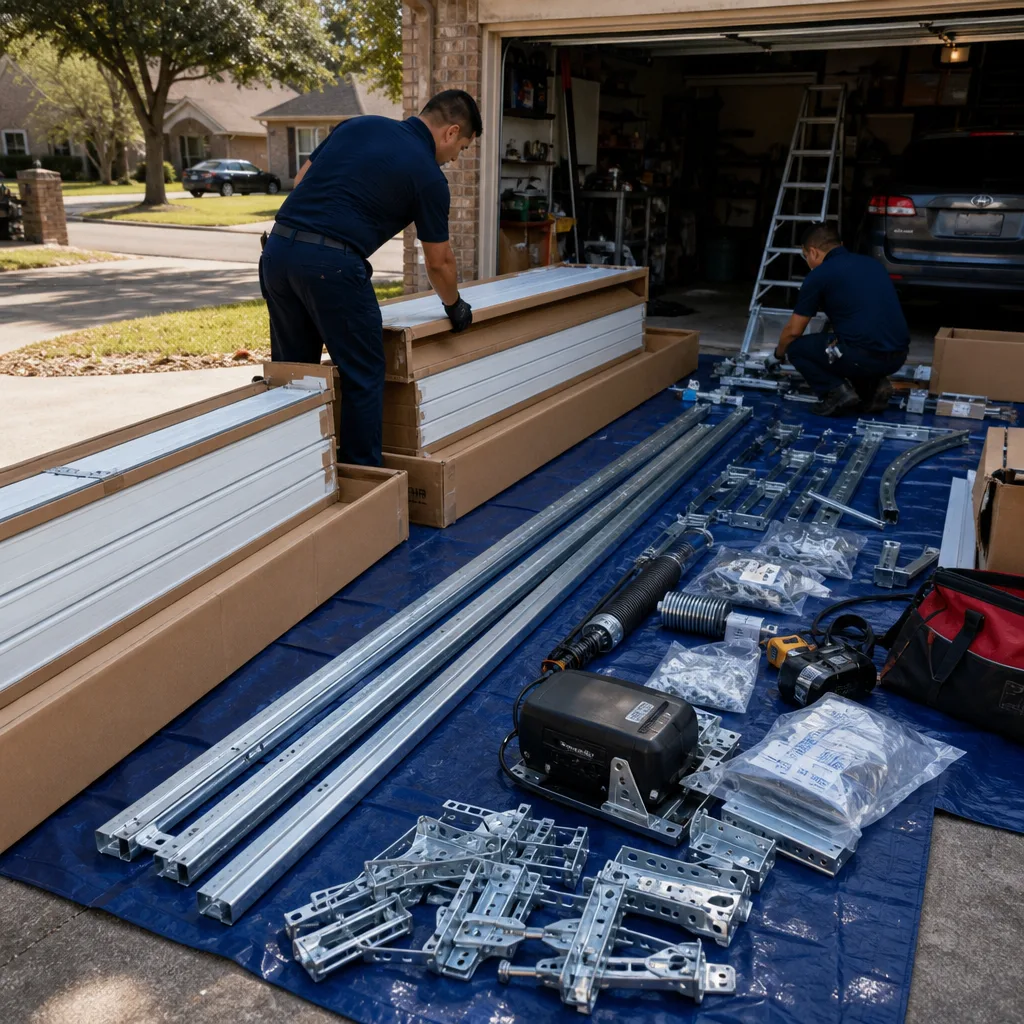
Incorrect lubrication causes more garage door problems in Atascocita than no lubrication at all. The wrong product attracts dust, hardens in heat, or drips onto vehicles. Here’s our specification:
| Component | Product | Frequency | Notes |
|---|---|---|---|
| Hinge pins | Synthetic high-temp grease, NLGI 2 | May and October | Pea-sized amount; wipe excess |
| Roller stems (steel rollers) | Synthetic high-temp grease, NLGI 2 | May and October | Do not lubricate nylon roller wheels |
| Torsion spring | Lightweight synthetic spray lubricant | October only | Coats to prevent corrosion; does not penetrate |
| Chain drive | Manufacturer-specified chain lube | October | Wipe old lubricant first |
| Screw drive (Genie) | Genie Lubriplate or equivalent | October | Apply along full screw length |
| Track interior | None | N/A | Clean with solvent only; lubricant attracts grit |
What never to use: WD-40 is a solvent and light penetrant, not a lubricant. It evaporates within days and leaves a residue that attracts dust. 3-in-1 oil thins in heat and drips. Automotive chassis grease is too thick for garage door components and hardens in cold weather.
Application technique: Apply lubricant with the door closed. Open and close twice to distribute. Wipe all excess with a clean rag. Excess lubricant on the torsion spring collects airborne grit that abrades the wire surface; excess on tracks creates a grinding paste.
DIY Maintenance vs. Professional Service
Some maintenance tasks are within competent homeowner capability. Others involve stored energy or electrical hazard that requires training and tooling. We draw the line at personal safety, not convenience.
Safe for DIY:
- Visual inspection of all components for wear, corrosion, or damage
- Lubrication of hinge pins and roller stems (not springs, not cables)
- Cleaning of safety sensor lenses with dry cloth
- Testing of safety reversal function (place 2×4 flat on floor; door must reverse on contact)
- Tightening of visible track bolts with socket wrench (do not over-torque)
- Replacement of remote control batteries and wall button batteries
Requires professional service:
- Any work on torsion springs or extension springs, including tension adjustment
- Cable replacement or tension adjustment
- Track realignment or replacement
- Opener logic board diagnosis or replacement
- Limit switch calibration on chain or belt drive openers
- Installation of new door or opener systems
The torsion spring is the critical dividing line. A standard 2-car garage door spring stores roughly 1,000 foot-pounds of torque. The winding bars used to add or release tension must be solid steel, precisely sized to the winding cone, and never removed while tension remains. We have responded to emergency calls in Atascocita where a homeowner’s screwdriver slipped from a winding cone; the resulting injury required surgical intervention. Clause 4 of The Haven Standard is why our technician photographs the failed part before quoting a replacement; it’s also why we insist that spring work stays in trained hands.
Our Garage Door Repair in Atascocita service includes a documented photo record of every visit, delivered to your email before the technician leaves. You see what we found and what we did, with timestamps and annotations.
Common Mistakes to Avoid
- Using the wrong lubricant for the season. White lithium grease applied in May turns to liquid by August and drips onto vehicles or garage floors. The stain is permanent on concrete. Use high-temperature synthetic grease rated for 450°F+ drop point.
- Ignoring the pre-hurricane window. Atascocita homeowners who wait until May to inspect storm readiness find contractor calendars full and supply chains strained. The March-April window exists for a reason; use it.
- Adjusting springs in summer heat. Expanded, heat-stressed steel behaves unpredictably. A spring that accepts adjustment at 95°F may fail catastrophically at 70°F when the metal contracts. Schedule spring work for the cold window.
- Cleaning sensors with spray cleaners. The photo-eye safety sensors near the floor have delicate lenses. Ammonia-based cleaners cloud the plastic and reduce beam strength. Use a dry microfiber cloth only.
- Over-tightening track bolts. The vertical tracks must allow slight movement as the door cycles. Over-tightened bolts distort track alignment and create binding. Finger-tight plus one quarter turn is sufficient.
- Neglecting the emergency disconnect test. Every garage door opener manual specifies monthly testing of the red emergency release rope. In Atascocita, where power outages accompany summer storms, this function is critical. Test it quarterly, not annually.
- Assuming all rollers need lubrication. Nylon rollers with sealed bearings require no lubrication; grease on the wheel surface attracts dust and accelerates wear. Steel rollers need grease on the stem only. Identify your roller type before applying anything.
When to Call a Professional
Call for service when you observe any of the following: a broken spring (visible gap in the coil, or the door feels twice as heavy to lift manually); a frayed or separated lift cable; a door that has come off its tracks; an opener that hums but does not move the door; or any sudden change in operation after a storm. These conditions involve stored energy, electrical hazard, or structural risk that exceeds homeowner-level intervention.
Servo Garage Doors Atascocita offers free estimates in Atascocita. Call (346) 616-9278 to schedule. Our technician arrives with a written price and scope before any work begins, per Clause 1 of The Haven Standard. You’ll receive a documented photo record of findings and completed work, and our 365-Day Done Right Promise covers every repair we perform.
Frequently Asked Questions
A professional tune-up in Atascocita typically runs $120-$180 and includes lubrication, safety testing, spring tension measurement, and a documented photo record. Major repairs identified during maintenance, such as spring replacement ($280-$650) or cable replacement ($150-$250), are quoted separately with a flat written price before work starts. Call (346) 616-9278 for an exact quote; estimates are free.
No. Visual inspection, lubrication of hinges and roller stems, and safety sensor cleaning are safe homeowner tasks. Any work involving torsion springs, lift cables, or opener electrical components requires training and specialized tools. The stored energy in a torsion spring can cause serious injury. Servo Garage Doors Atascocita handles these tasks with calibrated equipment and documented procedures.
Twice yearly: in May, before peak heat, with high-temperature synthetic grease; and in October, after thermal expansion stress has peaked, with inspection of all components. This schedule aligns with Atascocita’s actual weather calendar rather than a generic spring-fall approach.
Heat thins lubricant, softens nylon rollers, and expands metal components. The combination increases friction at hinge points and allows roller deformation that creates vibration. If noise increases from May through September, schedule an October audit; the noise source will be measurable by then.
No. Servo Garage Doors Atascocita provides a flat, written price and written scope before any work begins. Clause 1 of The Haven Standard prohibits starting work without documented customer agreement on price. If additional issues are found during service, we stop, document with photos, and quote separately. Nothing is added without your written approval.
A steel door with standard 10,000-cycle springs lasts 12-18 years in Atascocita with proper maintenance, compared to 15-25 years in milder climates. The thermal cycling and humidity accelerate wear on springs, rollers, and bottom seals. Upgrading to high-cycle springs (25,000-30,000 cycles) and EPDM weatherstripping extends this to 20-25 years. We assess remaining life during every service call and quote replacement only when repair is no longer economical.
The Bottom Line
Atascocita’s garage doors face a five-month thermal stress test every summer, a hurricane season that demands preparation, and a humidity profile that initiates corrosion faster than inland climates recognize. The homeowners who avoid emergency repairs are those who abandon the generic four-season schedule and work to the actual calendar: March-April for storm readiness, May for heat-rated lubrication, October for post-summer component audit, and December-January for precise spring adjustments in cold-stabilized steel. Document what you find, use the correct products for the conditions, and know which tasks belong to trained technicians. The cost of prevention is always lower than the cost of failure, and in Atascocita’s climate, the margin for error is narrower than the map suggests.
Written by Marcus Deller, Owner at Servo Garage Doors Atascocita, serving Atascocita since 2015.